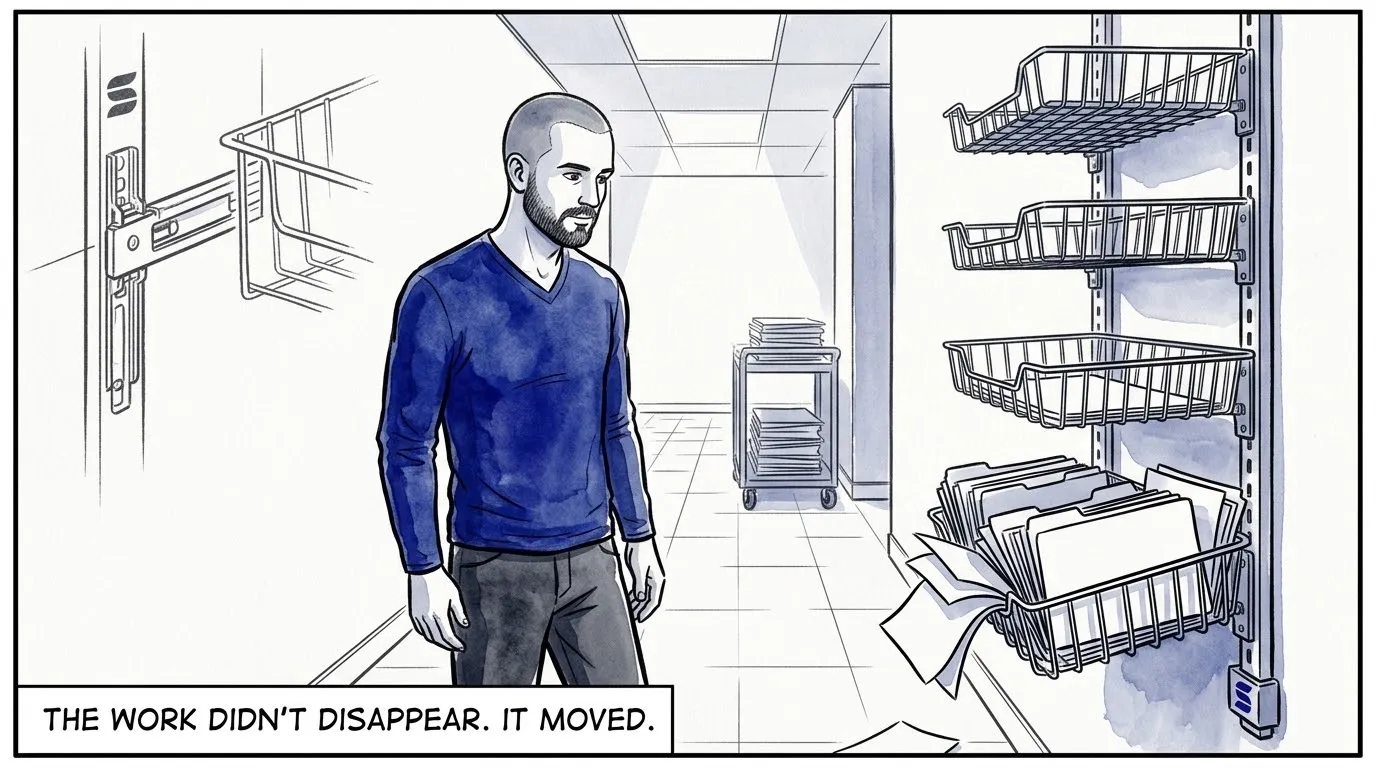
The work didn’t disappear when you handed it off. It just moved somewhere you stopped watching.
Something always falls out the bottom of a delegation chain.
It is not a skills problem. It is not a planning problem. It is the basic physics of how capacity works inside an organization.
When you hand work to someone who is already busy, they drop something lower-priority or pass it further down. That chain continues until it hits someone with no one to pass to. At that point, the work gets absorbed or something else gives way.
Not many leaders stop to check. They feel the relief of the handoff and move on. The cost surfaces weeks later as a missed deadline, a gap in documentation, or an answer in a skip-level conversation that makes you stop and think. That cost is whatever fell out at the end of the chain.
Here is what makes this worth naming: there is no shortage of advice on delegation. There are guides on how to delegate clearly, how to delegate without micromanaging, how to build autonomy through delegation. According to the DDI Global Leadership Forecast 2025, only 19% of rising leaders demonstrate strong delegation skills. That library is genuinely needed.
The leaders who already delegate well are the ones most likely to miss this. They are not watching for it. Because when you do the handoff right, the cascade still happens.
Why Technical Work Becomes Invisible After You Delegate It
Technical work is already hard to see from above. Migrations, documentation backlogs, testing cycles, API cleanup: none of it is obvious to someone not in the weeds. When you delegate a technical task and move on, you are not just handing off a to-do item. You are disconnecting from a thread.
The person you delegated to is managing their own thread. They may pass the task to someone on their team. That person is managing their own thread. At each step, the original task gets further from your view and closer to someone who has no clear channel for saying “I do not have capacity for this.”
The gap this creates is not about hiding information. It is not about anyone choosing to be opaque. It is about the absence of a natural feedback mechanism.
The work moves down. The signal about what happened to it does not automatically move back up.
In most engineering organizations, that signal only surfaces in three situations: when something misses a deadline, when someone raises a concern in a 1-on-1, or when a leader specifically asks. The first two are reactive. The third is the one worth building into how you manage.
The Technical Visibility Gap That Delegation Creates
The scale of this problem is not small. A 2025 analysis from Runn.io found that over half of organizations identify capacity planning as a pressing need. Only 6% feel they are doing it effectively. (Source: Runn.io Capacity Planning Statistics)
That means most organizations are operating without a clear picture of what their teams can actually absorb. When a leader delegates into that environment, they are not just handing off a task. They are dropping a stone into water and never watching for ripples.
The Gallup State of the Global Workplace 2025 adds another dimension: manager engagement has dropped from 31% in 2022 to 22% in 2025. Leaders and managers are reporting higher stress and lower capacity. (Source: Gallup, via mo.work) The teams these leaders are delegating to are not carrying slack capacity. They are already full.
When you delegate into a full team without a capacity conversation, you are not adding work to an empty bucket. You are adding it to one that is already at the rim.
This does not mean stop delegating. It means change the assumption. The assumption that “they will say something if it is too much” is not reliable. The skip-level conversation is one of the few tools that creates an environment where they actually do.
Technology Leader Communication: Skip-Level One-on-Ones as Your Delegation Visibility Tool
The skip-level 1-on-1 is designed to give you access to what your managers’ teams are actually experiencing. Not just what your managers report. It is also one of the best tools for tracking where delegated work eventually landed.
If you have not run skip-level conversations before, the setup is simple. Here is a full guide: [A Guide for Skip Level One-On-Ones]. The short version: you schedule one-on-ones with the direct reports of your direct reports. Not to go around your managers, but to understand what the organization looks like two levels down.
In the context of delegation, the questions that matter most are:
“What has landed on your plate this month that was not planned?”
“What did you have to set aside to make room for it?”
“Is there anything that has quietly fallen behind that I might not know about?”
“If your manager asked you today what was at risk, what would you say?”
People at this level rarely volunteer capacity problems to their own manager. Saying “I am overloaded” can feel like saying the manager made a bad call when they delegated something. The skip-level conversation removes that barrier. There is more distance, and with more distance comes more honesty.
What you hear will not always trace back to something you delegated. But when it does, you have a choice: redirect the work, adjust expectations, or make a deliberate decision that the cascade was acceptable. The point is not to prevent the cascade. The point is to see it and decide consciously, rather than discover it by accident.
Three Delegation Patterns That Create Engineering Burnout Downstream
Not every cascade happens because a leader delegated carelessly. Some of the most common delegation problems look like good practice on the surface.
Delegating without a capacity question first. Handing off a task without asking “what would have to give to make room for this?” assumes the person has slack. They usually do not. That three-minute conversation prevents a three-month gap in visibility.
Following up only with the person you delegated to. “Handled” may mean the work was passed down and accepted. It does not mean it was absorbed without cost. Ask two levels down: “Has anything from last month’s handoff touched your team?” That question surfaces what you would otherwise miss.
Closing the loop at completion instead of at absorption. Delegation often gets treated as complete the moment the task is done. The more useful close is: “What did you or your team end up setting aside to get this done?” That question tells you the real cost of the delegation, not just whether the output arrived.
None of these require a new system or additional meetings. They require a slightly different question at an existing touchpoint.
Monday Action
This week, pick one thing you delegated in the last month. Before you do anything else, find out what the person at the end of the chain set aside to make room for it. One question, one conversation. You will know more about how your organization is actually carrying your decisions than you did before.
If you want to understand how to run effective skip-level conversations, start here: A Guide for Skip Level One-On-Ones.
What is the furthest down your organization you have ever traced a piece of work you originally delegated?
You’re great at the work. Let’s make you impossible to ignore.
If you are looking for help understanding how your decisions land across your team and building visibility into what your organization is actually carrying, consider reaching out. Jesse Stafford Coaching
You're great at the work. Let's make you impossible to ignore.